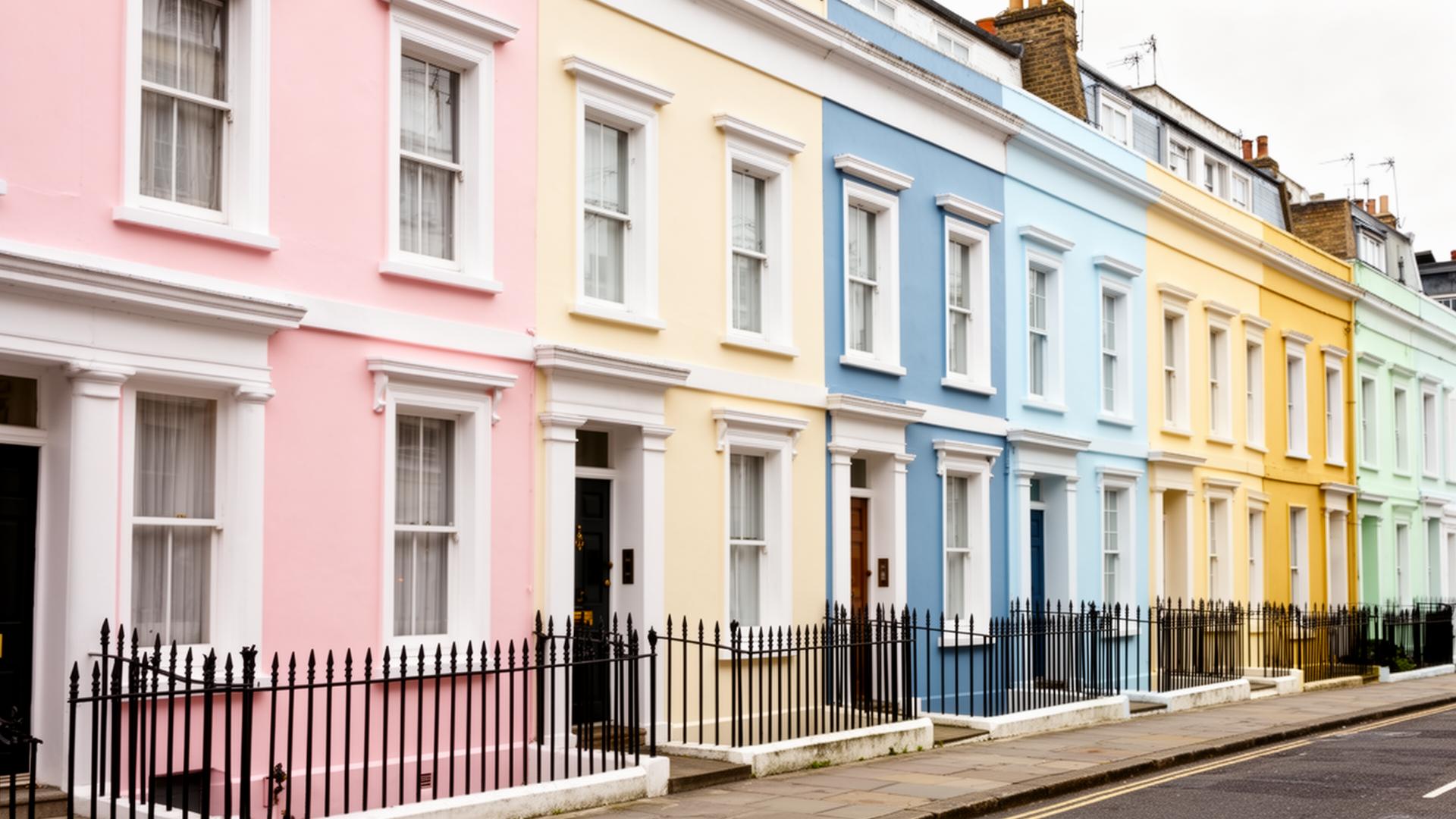
London sits on a deep belt of shrinkable London Clay. In hot, dry summers this clay loses moisture and contracts, particularly under properties with mature street trees nearby, a leading cause of subsidence in suburbs from Ealing to Bromley.
The ground beneath London
Most of the capital sits on the London Clay Formation, a stiff, fissured, highly shrinkable clay with plasticity indices typically between 40 and 60. Seasonal drying can extend two to three metres below ground level in extreme summers, which is well below the founding depth of most pre-1965 housing stock.
What that means for a survey here: Conservation-area and Tree Preservation Order restrictions across many London boroughs frequently rule out tree removal as a remedy, which pushes monitoring, root barriers and crown-management agreements with the local authority into the recommended response more often than they appear elsewhere in the UK.
London housing stock and what it means for foundation behaviour
Predominantly late-Victorian and Edwardian terraces, 1930s semi-detached suburbs, and post-war infill, much of it built on shallow strip foundations laid long before modern BRE guidance on foundation depth in shrinkable clay.
The mix matters because the typical foundation depth, wall construction and drainage age vary enormously between these property types. A proportionate diagnosis in London starts with reading the building before reading the cracks.
London neighbourhoods specialists in our network frequently cover
Enquiries from these London suburbs and local areas are routinely matched to a local firm in our network. Coverage extends across the wider Greater London, postcodes outside this list can still be served; pick the nearest listed area and we will pass your details to a qualified specialist firm covering your location.
Tree species commonly implicated in local cracking enquiries
The species most often relevant to subsidence diagnoses in London include london plane, english oak, lombardy poplar, lime and horse chestnut . Mature individuals of these species sitting within roughly one tree height of a shallow-founded London property are a routine input into the diagnostic conversation, though tree proximity alone does not amount to a diagnosis, and many local enquiries that look tree-driven on first inspection turn out to be drainage-led on closer reading.
Named local triggers commonly seen in London subsidence enquiries
- Mature street trees within 15 m of shallow foundations on London Clay
- Successive dry summers reactivating dormant clay-shrinkage damage
- Failed Victorian shared drains softening party-wall foundations
- Loft conversions and rear extensions adding load to already-stressed walls
A representative London case
The following is an illustrative summary of the type of enquiry commonly seen in London and is not a specific client case study.
A representative London instruction looks like this: a Victorian terrace in a leafy borough develops a stepped diagonal crack to a rear bay after the third hot summer in a row; the homeowner's insurer suggests underpinning. On inspection, the crack pattern is consistent with seasonal clay shrinkage rather than active subsidence, and the proportionate recommendation is a twelve-month monitoring programme through a wet winter before any structural intervention is considered.
What an independent London subsidence survey typically involves
A focused inspection by an accredited surveyor or structural engineer, followed by a written report. The inspection typically covers external elevations, internal walls and ceilings, accessible drainage, floor levels, and any mature trees within twenty metres , read against the specific London geology and housing stock context set out above. Crack patterns are sketched, widths measured against a calibrated gauge, photographs taken against a scale reference. The output is a clear diagnosis, a BRE damage classification, and a proportionate recommended next step you can hand to your insurer, buyer or lender.
Fees for London surveys
Fees for a London subsidence survey are quoted individually based on the property and the situation, there is no flat tariff. See the survey cost page for a plain-English account of what actually drives the fee. Add-on services like CCTV drainage and cause investigation and monitoring are quoted separately when warranted.
For London insurance claims and contested cases
A meaningful share of London enquiries comes from homeowners pushing back on insurer-led recommendations for underpinning that the underlying evidence, read against the specific local geology and tree context above, does not support, or homeowners whose subsidence claim has been rejected on grounds they want a second opinion on. Independent specialist firms in our network act as the engineering counterweight in those conversations. More on insurance claim support.
Coverage around London
Specialist firms in our network covering London routinely also serve all 32 London boroughs and the City and the M25 commuter belt including Watford, Romford, Sutton and Dartford. If your postcode is further afield, pick the nearest listed location or send the photo enquiry and a qualified specialist covering your area will pick it up, subject to availability.
How to speak to a specialist in London
Send photos of the cracks and a brief description through the form on this page. A qualified subsidence specialist will review your enquiry personally and reply with an honest opinion on whether a paid inspection is warranted. If it is, you'll be given a clear quote before anything is booked. No commission on the outcome , independent diagnosis is the only product.