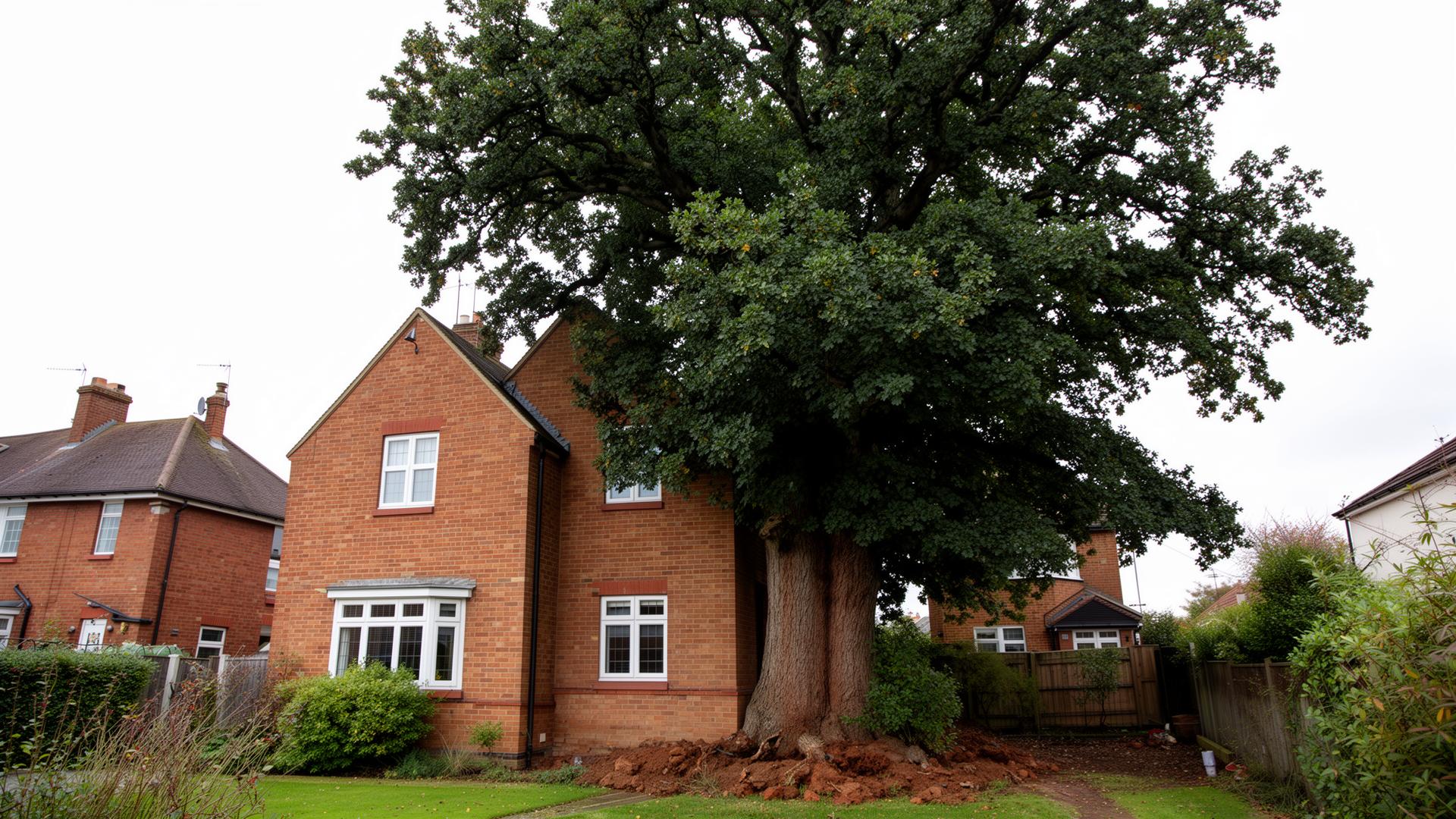
UK subsidence is overwhelmingly caused by one of five mechanisms, and the right remedial response depends entirely on which one is in play. A contractor who recommends underpinning before identifying the cause is proposing a structural fix to a problem they have not yet diagnosed , which is why an independent cause investigation is almost always the most valuable money you spend in the process.
1. Clay shrinkage
By a large margin the most common cause of UK subsidence claims. Several of the UK's underlying soils, London Clay across the South East, Gault Clay in parts of East Anglia and Surrey, Oxford Clay across the South Midlands, Mercia Mudstone across the West Midlands and parts of the North West, and Kimmeridge Clay in Wiltshire and Dorset, shrink substantially when they lose moisture. In a dry summer, the soil beneath a shallow foundation contracts and the foundation drops. The standard diagnostic signal: an insurance industry that sees claim volumes triple or quintuple in the year following a hot summer like 2003, 2018 or 2022.
2. Tree-root influence on shrinkable clay
A mature tree on or near a shrinkable-clay site amplifies clay shrinkage dramatically. The roots actively draw moisture out of the clay throughout the growing season, often to depths well below the foundation, producing localised drying and contraction the seasonal rainfall pattern cannot replenish. Poplars, willows, oaks, eucalyptus and elms are the worst offenders; their effective root influence on a clay site can extend to a horizontal distance equal to or greater than their full mature height. A 20-metre oak fifteen metres from a foundation on London Clay is a textbook subsidence risk.
3. Drainage failure
A leaking, fractured or root-invaded foul or surface-water drain underneath or beside a property can wash fines out from under a footing for months or years before any visible damage appears. The result is a slow, irregular settlement of the affected corner of the structure. The damage pattern often mimics clay shrinkage, which is why a CCTV drainage survey is the first cause-investigation step in most cases. Drainage failure is also the cause most commonly missed by contractor "free surveys", because the camera work is a separate sub-contract they do not always commission before reaching their conclusion.
4. Mining settlement
Across parts of the Midlands, the North East, South Wales and central Scotland, the legacy of historic coal, salt, ironstone or limestone mining produces occasional ground settlement above old workings. Modern Coal Authority records cover most of this, and a Coal Authority search is part of standard conveyancing in affected postcodes. Where the property sits above shallow workings, the damage is often sudden rather than progressive, and the engineering response involves consultation with the Coal Authority alongside the structural survey.
5. Washout into solution features
Chalk and limestone areas, parts of Norfolk, Hertfordshire, the Chilterns and the Yorkshire Wolds, can host underground solution features that periodically wash out (sinkholes in the dramatic cases, gradual settlement above small voids in the everyday ones). This cause is rarer overall but has a meaningful regional incidence. A BGS GeoIndex check and, where warranted, geophysical investigation are the diagnostic tools.
Causes commonly mistaken for subsidence
- Heave. The opposite of subsidence, ground swelling upward, usually after a large tree is removed or a leaking drain is repaired. Heave is mechanically and legally different from subsidence and is treated differently by insurers.
- Settlement. Normal, expected consolidation of new ground under a new building. Not a defect.
- Thermal movement. Seasonal expansion and contraction of building fabric, particularly visible at junctions between dissimilar materials.
- Lintel and beam deflection. Cracking above doors and windows from sagging or rotated lintels rather than ground movement.
- Original construction defects. Inadequate foundations on the original build, particularly common in pre-1900 stock and post-war emergency housing.
How a survey identifies the cause
A focused subsidence survey reads the crack pattern, maps the property and its context, identifies any shrinkable-clay geology, profiles the nearby trees, and inspects accessible drainage. From those inputs the chartered surveyor forms a working hypothesis about the most likely cause and, importantly, identifies the cheapest investigation that would confirm or rule it out. For most homeowners the sequence is: visual survey, then CCTV drainage, then (if needed) root and soil assessment. Trial pits and borehole sampling are reserved for higher-value cases or situations where the diagnosis is contested.
Why identifying the cause is more valuable than rushing to repair
Underpinning a foundation without removing the cause is the most expensive way to deal with subsidence in the UK. If the cause is a leaking drain and you underpin around it, the next foundation along is the next one to fail. If the cause is a mature tree and you underpin without addressing the tree, the seasonal moisture cycle will continue to drive movement at a different point. Cause-removal, drain repair, root barrier, leak repair, monitoring of seasonal cycling, resolves a large share of UK subsidence cases without ever progressing to structural underpinning, and is consistently the most cost-effective path that the Financial Ombudsman Service endorses in disputed claims.
Want to know which cause likely applies to your property? Send us photos and a brief description , we will tell you what we suspect and what investigation would confirm it.